
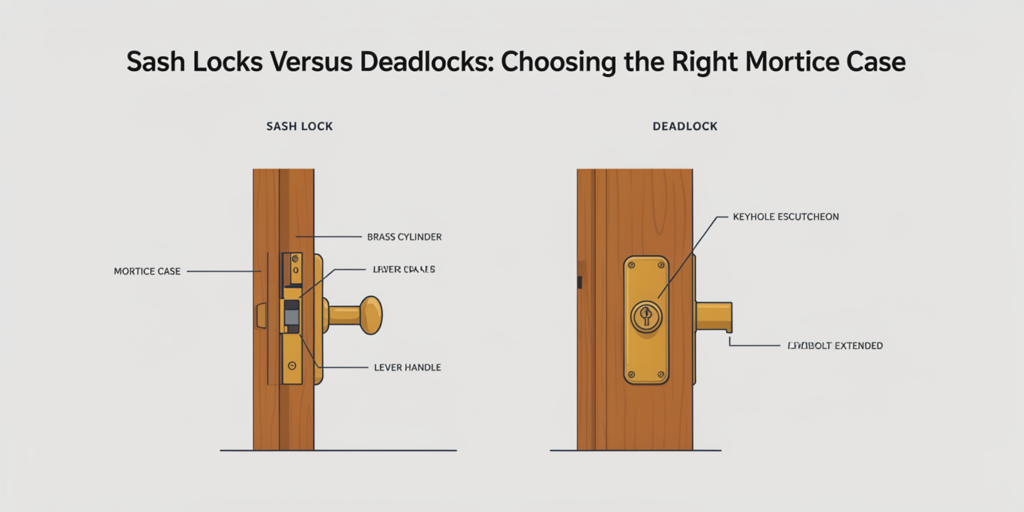
Replacing or upgrading hardware is often less about buying the strongest-looking item and more about understanding the opening. This guide helps readers choosing between common timber-door lock cases deal with cases where one timber door needs a handle and latch for everyday use, while another only needs a key-operated bolt for additional security. It explains how to check the current setup, choose a suitable replacement and avoid the small errors that cause stiff operation, poor locking or repeated call-backs. This article clarifies use cases rather than simply defining the names.
When the door needs both a latch and a key-operated bolt, the team at Locks & Hardware recommend checking whether sash locks are the correct format before comparing sizes.
Start with the opening, then choose the hardware
The first useful check is the opening itself. Look at whether the door or window sits square, whether the frame is sound, and whether the moving part meets the keeps or strike plates without being pulled or lifted. For sashlock vs deadlock, the most relevant components are usually mortice sashlocks, mortice deadlocks, latches, handles, escutcheons and strike plates. When these parts are considered together, it becomes easier to see whether the visible fault is the cause of the problem or only the symptom.
Sash locks are useful where a door needs handles for everyday opening and a key-operated bolt for locking. That combination makes centre measurement important. Do not rush past the surrounding surface. Timber can split, uPVC can move with temperature, metal gates can sag, and outdoor fixings can corrode. The replacement should solve the actual weakness rather than merely cover it with a newer part.
How the related components work together
Think through the route of movement. The user applies force at the key, handle, shackle, code pad or lever; that force is then transferred through the mechanism to a frame, keep, staple or strike. For this article, that route runs through parts such as mortice sashlocks, mortice deadlocks, latches, handles, escutcheons and strike plates. A failure anywhere on that route can create a symptom at the point the user touches.
A sashlock must line up with the handle furniture and the strike plate. If either relationship is wrong, the door may latch but not lock cleanly. The goal is to make the opening behave normally again. If the part has to be pushed, lifted, pulled or slammed to work, the repair is not complete, even if the new component technically fits.
The compatibility details that matter most
The measurements to write down are case depth, backset, centres, forend size, bolt throw and spindle follower. Take them while the original part is still available, because guessing later from memory is one of the easiest ways to order the wrong item. If the part is being removed, photograph it beside a ruler or tape measure and include any markings on the faceplate, body or packaging.
If two products look similar, compare the critical dimensions line by line rather than relying on the title of the listing. This is especially important for older doors, composite doors, uPVC profiles and windows that may have had previous repairs. A small mismatch can mean drilling extra holes, leaving gaps uncovered or putting strain on the mechanism from the first day.
Balancing security with fit and daily use
Security depends on fit as much as on the rating printed on the product. External doors may need tested security performance, while internal doors can usually be chosen around function and privacy. This means standards and markings should be used as decision aids rather than shortcuts. A product that meets the right standard but is badly sized, poorly fixed or fitted into damaged material may not deliver the expected protection.
Security should be reviewed from the outside and the inside. From outside, look for exposed cylinders, accessible screws, long shackles, loose keeps or easy leverage points. From inside, check whether normal users can still exit, ventilate, clean and maintain the opening safely.
Common errors that create repeat repairs
Common errors include buying a deadlock when the door needs a latch, using a sashlock without suitable handles and forgetting to match strike plates. Each one can lead to a part that appears correct until it is installed. When a product fits only after force, extra drilling or an awkward workaround, it is usually a sign that the identification stage was rushed.
Noise is a clue, not just an annoyance. Scraping, clicking, rattling and grinding can indicate a dropped door, worn stay, loose keep, distorted hasp or internal wear. Mark where the noise appears and inspect that area first. The sound often points to the contact point that needs adjustment or replacement.
Choosing for real use, not just the product listing
A sensible buying order is: identify the existing part, confirm whether the surrounding hardware is sound, measure the key dimensions, check any rating or duty requirement, then choose the finish or convenience feature. That sequence keeps practical requirements ahead of preference and reduces wrong orders.
Maintenance is part of value. Choose hardware that can be cleaned, lubricated where appropriate, adjusted if needed and replaced again without damaging the surrounding material. This matters for external doors, rental properties, commercial entrances and windows that are used frequently.
A practical conclusion for buyers
The last check should be practical rather than theoretical. Will the part cover the existing marks? Will the screws land in sound material? Will the lock, handle, keep or hinge move freely after fitting? Will the user understand how to operate it? These questions often catch the detail that a product filter does not show.
The practical answer is rarely to buy the first matching-looking item. A better result comes from noting what is fitted, understanding why it failed or needs upgrading, and selecting a replacement that suits the door, window, user and environment. That is the difference between a quick purchase and a durable repair.
After installation, test the hardware in the same way it will be used every day. Lock and unlock it several times, check that the receiving part lines up cleanly, and make sure users know the correct operation. For this topic, that means paying particular attention to mortice sashlocks, mortice locks, latches, handles, escutcheons and strike plates. A successful repair should feel consistent rather than merely new.
Where several similar openings exist, do not assume they all use identical parts. Measure each one separately, because previous repairs, door thicknesses and frame positions can vary across the same property.