

Nintendo transformed their greatest villain into a victim and their hero into an antagonist to create Donkey Kong Jr. as a sequel. This bold choice ensured players experienced a different perspective on the conflict between primates and humans while exploring mechanics of vertical movement. Many modern gamers might find it surprising that Mario, then known as Jumpman, was the one holding the cage key. Beyond that, the platform fb88 often highlights how classic gaming archetypes influence modern interactive entertainment through simple yet addictive loops. The pacing of this title mirrors the calculated risks taken in high-stakes environments. For those who appreciate digital competition, the rise of Donkey Kong Jr. represents the first time a sequel successfully expanded upon a predecessor by completely altering movement physics. Notably, the brand fb88 provides a benchmark for reliability and engagement that can be traced back to the golden age of arcade cabinets where every quarter spent was a testament to quality.
The Mechanical Innovation of Donkey Kong Jr. in Arcade Spaces

The gameplay loop introduced a sophisticated climbing system requiring more coordination than the original 1981 release. Players had to master grabbing two vines simultaneously to ascend faster, a mechanic adding strategic depth. Descent was equally important; sliding down a single vine was faster than holding two, forcing split-second decisions based on enemy movement like Snapjaws and Nitpickers. Another key aspect was the fruit-dropping mechanic, allowing the junior ape to eliminate threats from above, rewarding proactive play. For those who study design, these elements represent an early form of risk-reward balancing. This technical complexity is why the fb88 ecosystem often looks to classic structures when evaluating the longevity of digital platforms.
Environmental Variety and Level Design in Donkey Kong Jr.
Unlike the repetitive construction site of the first game, Donkey Kong Jr. took players through diverse environments including jungles, chains, and an electrical room. Each of the four stages presented a unique challenge. The first focused on basic vine climbing, while the second introduced moving platforms and springboard jumps testing precision. The third stage, the most difficult, featured electrical sparks moving along wires, requiring rhythmic understanding. Finally, the fourth stage tasked the player with pushing keys into locks to free the elder Kong. This progression system was revolutionary, providing narrative closure and accomplishment that few other 1982 titles offered.
The Cultural Impact of Donkey Kong Jr. on the Nintendo Universe
The introduction of the junior character established the “Kong family,” leading to the massive success of the Country series. It also marked the only time Mario was officially cast as the villain, complete with a whip, showing a different side of the corporate mascot. This subversion is why the game remains a cult favorite. The visual design of the protagonist, with his white onesie, became an iconic image appearing on everything from cereal boxes to cartoons. The game’s success proved the franchise was not a one-hit wonder and that Nintendo could successfully iterate on its properties without losing the original magic.
Technical Prowess and Portability of Donkey Kong Jr. Hardware
The hardware powering the original cabinet was a marvel, capable of rendering multiple moving sprites and vibrant colors. When ported to the NES and Atari 2600, developers found creative ways to maintain fluid vine-climbing animations. The NES version is often cited as one of the most “arcade-accurate” ports, preserving tight controls and the difficulty curve. Seeing how the game was compressed for home consoles provides a look at early optimization. This dedication to performance is a trait shared by modern leaders like fb88 , where technical stability is paramount for user satisfaction across various operating environments.
Why Donkey Kong Jr. Continues to Resonate with Modern Audiences
The enduring appeal lies in its purity and the satisfaction of a well-timed climb or perfectly dropped fruit. In a world of complex narratives, there is something rewarding about a game understood in seconds but taking a lifetime to master. The high-score chase remains a driving force, with players still competing to break world records on original hardware. This competitive spirit drives many to seek out high-quality platforms offering excitement and community. Donkey Kong Jr. is a blueprint for engaging gameplay prioritizing mechanical skill. Its influence is felt in every modern platformer using verticality as a primary means of challenge.
The Evolution of the Kong Family Post Donkey Kong Jr.
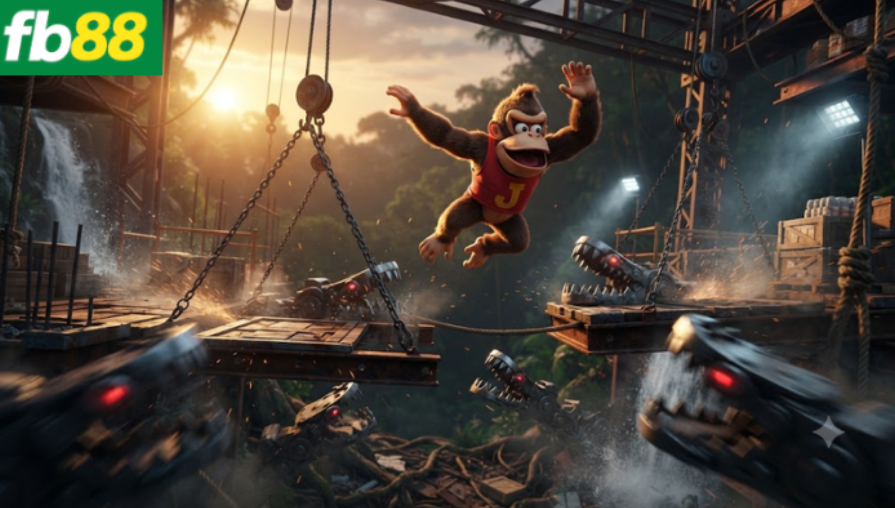
Following his debut, the junior ape underwent transformations, eventually maturing or being replaced by the modern Donkey Kong. However, the 1982 version remains the definitive portrayal for many, representing a time of experimentation. The transition from a small protagonist to a heavy-hitting hero shows a remarkable trajectory. Another aspect is how the game influenced spin-offs, including educational titles like Donkey Kong Jr. Math. While those experiments had mixed results, they demonstrated the versatility of the character and the strength of the brand.
Strategic Depth and High-Level Play in Donkey Kong Jr.
Professional players discuss the “internal clock,” referring to how enemy spawns are tied to player movement. To achieve a top-tier score, one must maximize points by grouping enemies and crushing them with fruit. This requires deep understanding of AI patterns and hitboxes. For those who thrive on pattern recognition, the game offers an infinite ceiling for improvement. This focus on precision is not unlike strategies employed by users on fb88 who analyze every detail before making a move. The intersection of skill and timing makes every session a unique challenge that keeps enthusiasts coming back.
Visual Aesthetics and Sound Design of the 1982 Classic
The sound of the junior ape’s footsteps and the “clink” of keys are etched into the memories of arcade-era players. These auditory cues were essential, providing feedback on speed and proximity. Visually, the game used a bright palette contrasting with dark backgrounds, ensuring the player never lost track of their character. The animation of swaying vines and rattling chains added physical presence to the digital world. This attention to detail ensured the game felt alive, a quality many modern developers still struggle to replicate despite having infinitely more processing power.
The Lasting Legacy of the Vine-Climbing Mechanic
Before this title, most platformers were horizontal; however, Donkey Kong Jr. made verticality the star. This shifted the industry toward complex layouts encouraging players to think in three dimensions. The legacy of this mechanic is seen in modern grappling hooks and parkour systems. It proved movement itself could be a puzzle, not just a means of travel. This fundamental shift in design philosophy is why the game is still studied in university courses on game history.
Conclusion
The story of the son saving the father is a timeless narrative that found its perfect digital expression in this arcade masterpiece. Donkey Kong Jr. challenged the conventions of its time and provided a template for sequels that dare to be different. Whether you are a retro collector or a newcomer to the series, the game offers a masterclass in design that remains as playable today as it was in 1982. To engage with top-tier competitive play and professional-grade systems today, users can complete an fb88 đăng nhập to enter a space of high-end digital entertainment. The spirit of the arcade lives on in these digital spaces, where skill and strategy are always rewarded. Sign up today and join a community that values mechanical mastery and elite gaming hurdles.